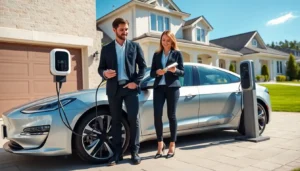
Electric vehicles are reshaping how people think about transportation. Sales have surged globally, with EVs accounting for over 18% of new car purchases worldwide in 2024. Governments offer incentives. Automakers invest billions. Charging stations pop up everywhere from grocery store parking lots to rural highways.
But what makes electric vehicles different from traditional cars? Are they actually better for the environment? And should someone buy one right now, or wait a few more years?
This guide breaks down everything buyers need to know about electric vehicles. It covers how they work, the different types available, their benefits, and the honest challenges owners face. It also looks at where the industry is headed next.
Table of Contents
ToggleKey Takeaways
- Electric vehicles now account for over 18% of global new car sales, driven by government incentives, expanding charging networks, and growing automaker investments.
- EVs cost roughly $0.04–0.06 per mile to operate compared to $0.12–0.18 for gasoline, saving owners thousands of dollars over a vehicle’s lifetime.
- Battery electric vehicles (BEVs) offer the lowest maintenance costs since they require no oil changes, have fewer moving parts, and use regenerative braking to extend brake pad life.
- Cold weather can reduce EV range by 20–40%, so buyers in extreme climates should factor this into their purchase decision.
- Solid-state battery technology expected by 2027–2028 could deliver 500+ mile ranges and 10-minute charging times, making electric vehicles even more practical.
- Electric vehicles are projected to reach price parity with gas cars by 2026–2027, eliminating the upfront cost barrier for most buyers.
How Electric Vehicles Work
Electric vehicles run on electricity stored in large battery packs instead of gasoline or diesel. The basic system is surprisingly simple compared to internal combustion engines.
A typical electric vehicle has three main components: the battery pack, the electric motor, and the power electronics controller.
The battery pack stores electrical energy. Most modern electric vehicles use lithium-ion batteries, the same technology found in smartphones, just scaled up dramatically. These packs sit beneath the vehicle floor, which lowers the center of gravity and improves handling.
The electric motor converts electrical energy into mechanical motion. Unlike gas engines with hundreds of moving parts, electric motors have very few. This means less can go wrong. Electric motors also deliver instant torque, giving EVs that quick acceleration feel drivers often mention.
The power electronics controller manages energy flow between the battery and motor. It determines how much power reaches the motor based on accelerator input.
When a driver presses the brake pedal, something interesting happens. The motor works in reverse, acting as a generator. It captures kinetic energy and sends it back to the battery. This process, called regenerative braking, extends driving range and reduces brake pad wear.
Charging an electric vehicle works similarly to charging a phone. Plug it in, electricity flows into the battery, and the vehicle is ready to drive. Charging speeds vary widely. A standard home outlet might add 3-5 miles of range per hour. A Level 2 home charger adds 25-30 miles per hour. DC fast chargers at public stations can add 100-200 miles in 30 minutes.
Types of Electric Vehicles Available Today
Not all electric vehicles work the same way. Buyers have several options, each with distinct advantages.
Battery Electric Vehicles (BEVs)
Battery electric vehicles run entirely on electricity. They have no gas engine, no tailpipe, and produce zero direct emissions. Popular examples include the Tesla Model 3, Chevrolet Bolt, and Ford Mustang Mach-E.
BEVs offer the lowest operating costs. Electricity is cheaper than gasoline in most areas. Maintenance costs drop because there’s no oil to change, no transmission fluid, and fewer parts that wear out.
The main limitation? Range anxiety. Most BEVs travel 200-350 miles on a full charge. Some premium models exceed 400 miles. For daily commuting, this works fine. For long road trips, drivers need to plan charging stops.
Plug-in Hybrid Electric Vehicles (PHEVs)
Plug-in hybrids combine a battery pack with a traditional gas engine. They can drive 25-50 miles on pure electricity before the gas engine kicks in.
PHEVs appeal to buyers who want electric driving for daily errands but need gas backup for longer trips. The Toyota RAV4 Prime and Jeep Wrangler 4xe are popular choices.
Hybrid Electric Vehicles (HEVs)
Standard hybrids like the Toyota Prius use a small battery that recharges through regenerative braking. They can’t be plugged in. The battery assists the gas engine to improve fuel economy.
Hybrids aren’t true electric vehicles, but they serve as a stepping stone for buyers hesitant to go fully electric.
Benefits of Owning an Electric Vehicle
Electric vehicles offer advantages that gas cars simply can’t match.
Lower fuel costs stand out immediately. Electricity costs roughly $0.04-0.06 per mile in most U.S. states. Gasoline costs $0.12-0.18 per mile. Over 100,000 miles, that difference adds up to thousands of dollars.
Reduced maintenance saves money and hassle. Electric vehicles don’t need oil changes. Brake pads last longer thanks to regenerative braking. There’s no transmission to service. Consumer Reports estimates EV owners spend about half what gas car owners pay on maintenance.
Environmental benefits matter to many buyers. Electric vehicles produce zero tailpipe emissions. Even accounting for power plant emissions, EVs generate 50-70% less lifetime carbon than comparable gas vehicles in most regions.
Better driving experience surprises many first-time EV drivers. The instant torque creates smooth, responsive acceleration. The low center of gravity (from floor-mounted batteries) improves handling. The absence of engine noise makes for a quieter ride.
Tax incentives reduce purchase costs. The federal EV tax credit offers up to $7,500 for qualifying vehicles. Many states add their own incentives. Some utility companies offer reduced electricity rates for overnight EV charging.
Home charging convenience changes daily routines. Owners wake up to a full “tank” every morning. No more gas station stops. No more watching fuel prices fluctuate.
Challenges and Considerations for EV Owners
Electric vehicles aren’t perfect for everyone. Potential buyers should understand the real trade-offs.
Higher upfront costs remain a barrier. The average new EV costs about $55,000 in 2024, though affordable options like the Chevrolet Equinox EV start around $35,000. Tax credits help close the gap, but the initial price tag still exceeds comparable gas vehicles.
Charging infrastructure gaps affect some regions more than others. Urban areas have plenty of public chargers. Rural areas? Not always. Apartment dwellers without home charging face daily inconveniences. Long trips require more planning than pulling into any gas station.
Charging time tests patience. Even fast chargers take 20-40 minutes for a significant charge. A gas fill-up takes five minutes. For road trips, this difference matters.
Range limitations in extreme weather deserve attention. Cold temperatures can reduce EV range by 20-40%. Hot weather impacts range less severely but still affects performance. Buyers in Minnesota or Arizona should factor this into their decisions.
Battery degradation happens over time, though slower than many fear. Most modern EV batteries retain 80-90% capacity after 100,000 miles. Manufacturers typically warranty batteries for 8 years or 100,000 miles.
Resale value uncertainty concerns some buyers. The EV market changes rapidly. A three-year-old EV competes against newer models with better range and features. Depreciation can hit harder than expected.
The Future of Electric Vehicles
The electric vehicle market is changing fast. Several trends will shape the next decade.
Battery technology keeps improving. Solid-state batteries promise higher energy density, faster charging, and longer lifespan. Major automakers expect commercial production by 2027-2028. These advances could deliver 500+ mile ranges and 10-minute charging times.
Prices are falling. Battery costs dropped 90% between 2010 and 2024. This trend continues. Analysts predict electric vehicles will reach price parity with gas cars by 2026-2027 without subsidies.
Charging networks are expanding rapidly. Tesla opened its Supercharger network to other brands. The federal government allocated $7.5 billion for EV charging infrastructure. Major retailers install chargers to attract customers. By 2030, public charging should be nearly as convenient as gas stations.
More models are coming. Every major automaker has committed to electric vehicle production. Trucks, SUVs, sports cars, and affordable compacts, every segment will have EV options. General Motors plans to sell only electric vehicles by 2035. Volvo set 2030 as its all-electric target.
Government policies push adoption. California banned new gas car sales after 2035. The European Union follows similar timelines. These regulations accelerate manufacturing investments and infrastructure development.
Electric vehicles aren’t just an alternative anymore. They’re becoming the default.